What Makes Testing Healthcare Software Essential for Safe and High-Performing Platforms?

Quick Summary:
Inadequate healthcare software can jeopardize patient safety, compromise data security, and hinder operational efficiency. Healthcare software testing ensures that applications, such as Epic software, telemedicine platforms, and EHR systems, function reliably, meet regulatory standards, and protect sensitive patient data. This blog examines the crucial role of software testing in healthcare, focusing on Epic software testing, automated testing solutions, and specialized healthcare software testing services that improve compliance, performance, and patient safety.
Table of Contents:
- Introduction
- The Importance of Healthcare Software Testing
- Key Types of Healthcare Software Testing
- Challenges in Healthcare Software Testing
- The Role of Automated Software Testing in Healthcare
- EPIC and Specialized Healthcare IT Testing Services
- Conclusion
The healthcare industry has embraced digital transformation through EHRs, telemedicine platforms, mobile health apps, and EPIC software, which manage patient records and clinical workflows. However, these applications must be reliable, secure, and compliant with regulations like HIPAA and HL7.
Healthcare software testing ensures that these systems function correctly, protect patient information, and integrate seamlessly with other healthcare platforms. Without comprehensive testing, errors in EPIC software or other healthcare applications can result in misdiagnoses, data breaches, and operational disruptions. Rigorous testing of healthcare software is thus essential, not just a best practice but a critical safeguard for patient safety and operational efficiency.
We help you with innovative approaches to managing supply chain costs in healthcare.
The Importance of Healthcare Software Testing
Healthcare software testing is the structured process of evaluating healthcare applications, including EHR systems, telemedicine platforms, mobile health apps, and EPIC software. This ensures they function correctly, maintain data security, and comply with regulatory standards. It validates functional and non-functional aspects, including performance, security, interoperability, and usability. By detecting defects and vulnerabilities early, testing healthcare software ensures accurate, safe, and reliable application performance.
Healthcare software testing is crucial for multiple reasons:
- Patient Safety: Ensures EPIC software and other healthcare applications perform accurately to reduce the risk of clinical errors.
- Regulatory Compliance: Verifies adherence to HIPAA, HITECH, and other healthcare regulations to maintain legal and ethical standards.
- Data Security: Detects vulnerabilities in sensitive healthcare data to protect against breaches in EPIC and other systems.
- Operational Efficiency: Identifies performance bottlenecks to ensure that hospital workflows and telemedicine platforms run smoothly.
Regular software testing in healthcare helps organizations enhance patient outcomes and maintain trust with regulatory authorities. Healthcare software testing services often provide continuous monitoring and updates for EPIC software to ensure consistent reliability.
Key Types of Healthcare Software Testing
Testing healthcare software requires a multi-faceted approach to ensure reliability, security, and compliance. Different methodologies cover functionality, performance, security, interoperability, and regulatory adherence, ensuring robust platforms like EPIC software.
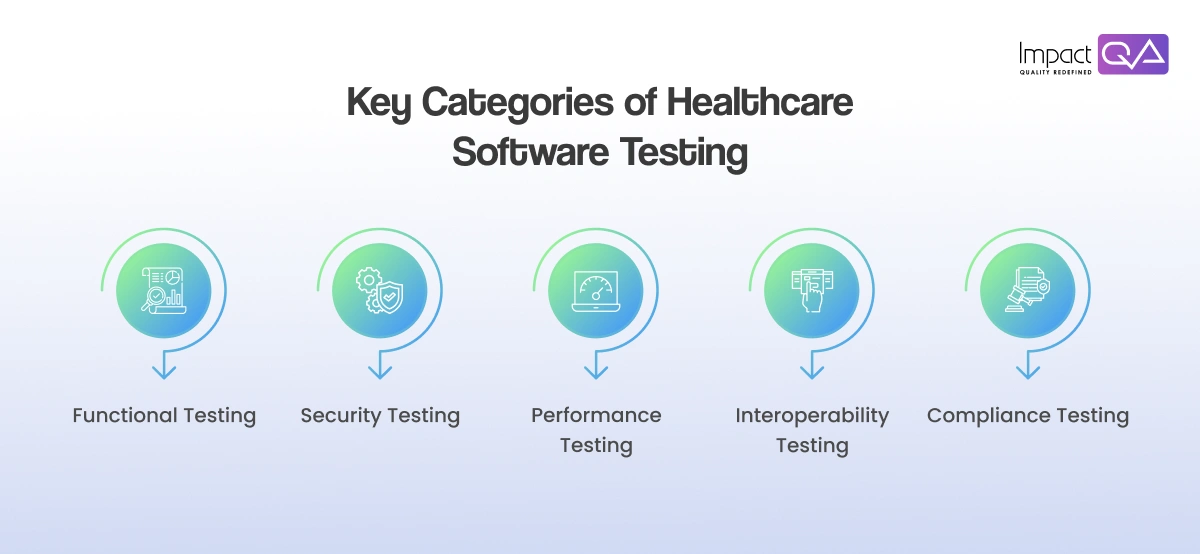
1. Functional Testing: Validates that EPIC software modules and applications perform intended tasks, such as scheduling, reporting, and data entry. It confirms accurate workflow execution under different scenarios.
2. Security Testing: Assesses system defenses against unauthorized access, ransomware, and breaches. Evaluates encryption protocols, authentication methods, and vulnerability points to protect patient information.
3. Performance Testing: Measures system response under peak usage. Monitors scalability, response times, and resource usage to ensure consistent application performance during high-demand periods.
4. Interoperability Testing: Confirms EPIC software can communicate with EHRs and telemedicine platforms. Tests data exchange accuracy and system compatibility across multiple applications.
5. Compliance Testing: Ensures adherence to HIPAA, HL7, and FHIR standards. Reviews patient data handling, storage, and processing procedures to maintain legal and ethical compliance.
Integrating automated approaches enhances testing coverage. Automated software testing in healthcare increases accuracy and efficiency while managing large-scale applications like EPIC effectively.
Challenges in Healthcare Software Testing
Software testing in healthcare is essential for patient safety, regulatory compliance, and operational efficiency. However, testing healthcare applications like EPIC software faces unique challenges that require specialized approaches, tools, and expertise.

1. Complex Regulations: Compliance with HIPAA, HITECH, and HL7 requires a deep understanding of healthcare standards. Testing must adapt to frequent regulatory updates, audits, and policy changes to ensure that all applications, including EPIC software, remain legally and ethically compliant.
2. Integration Complexity: EPIC software often needs to interface with legacy systems and third-party applications. Differences in data formats, protocols, and communication methods create significant technical challenges. Moreover, this makes seamless integration and accurate data exchange difficult without rigorous testing processes.
3. Data Sensitivity: Healthcare applications handle highly confidential patient information. Testing healthcare software must include secure environments, encryption checks, and access controls. Any oversight can result in data breaches, legal penalties, and loss of patient trust.
4. Resource Constraints: Limited budgets, staff, or expertise can restrict testing coverage. Organizations must prioritize critical areas, adopt automated software testing in healthcare, and leverage specialized healthcare IT testing services to maintain comprehensive quality assurance.
The Role of Automated Software Testing in Healthcare
Specialized healthcare IT testing services are essential for validating EPIC software and other healthcare applications. ImpactQA delivers tailored solutions using advanced testing methodologies and next-generation technologies.
- Expert Knowledge: ImpactQA’s testers understand clinical workflows, HIPAA compliance, and HL7 standards. This ensures EPIC software meets regulatory and operational requirements.
- Comprehensive Testing: Covers functional, performance, security, compliance, and interoperability testing across EPIC modules, EHR systems, and hospital management applications.
- Proactive Risk Mitigation: Identifies defects early to prevent clinical errors, data breaches, and regulatory violations using AI-driven automated testing.
- Resource Optimization: Outsourcing testing allows healthcare organizations to focus on patient care while ensuring EPIC software performs efficiently.
- Tailored EPIC Testing: Custom strategies validate patient management, clinical decision support, appointment scheduling, billing, and provider workflows.
We help you with innovative approaches to managing supply chain costs in healthcare.
Conclusion
The importance of healthcare software testing services is undeniable. Effective testing ensures EPIC software and other healthcare applications are reliable, secure, and compliant, protecting patients and supporting operational efficiency.
By leveraging specialized healthcare IT testing services and automated approaches, organizations can optimize EPIC software performance, prevent data breaches, and improve patient care. Providers like ImpactQA offer tailored solutions for EPIC and other healthcare platforms to ensure comprehensive validation across functional, security, and regulatory dimensions.
Share this post


Related Posts
Our Case Studies